










































TL;DR
A sensitive scalp routine works best when cleansing is mild, conditioning is rich, and styling avoids synthetic perfume, harsh sulphates, and heavy build-up. Choose fragrance-free or essential-oil-free options when reactive skin is a concern, then adjust product weight for waves, curls, coils, or locs.
A sensitive scalp curly hair routine has to clean the scalp without stripping the hair fibre, then hydrate textured strands without leaving irritating build-up. Hair: a protein filament that grows from follicles in the dermis, and textured hair often needs extra moisture because bends, curls, and coils slow the movement of scalp oils along the strand. For plant-powered care designed around waves, curls, coils, locs, and scalp comfort, That Good Hair offers fragrance-free options, COSMOS-certified organic ingredients, and reusable aluminium packaging.
Table of Contents
What is a sensitive scalp curly hair routine?
A sensitive scalp curly hair routine is a low-irritation wash day system that uses mild cleansing, careful conditioning, scalp-aware moisturising, and lightweight styling to protect textured hair and reduce dryness triggers. The best routine keeps the scalp clean, supports curl definition, and limits common irritants such as synthetic perfume and harsh sulphates.
Key insight: scalp comfort and curl definition are not separate goals; a routine that overloads the scalp often dulls curl pattern over time.
Research by Moody, van Dammen, and Wang (2022) examined how hair type, hair sample weight, and external hair exposures affect cumulative hair cortisol measurements, showing that hair characteristics and exposures matter in scientific assessment as well as everyday care study metadata. Hair care advice should therefore treat texture and product exposure as practical variables, not afterthoughts.
Core routine definition
Sensitive scalp: skin on the scalp that reacts easily to cleansing strength, fragrance, residue, weather, or styling tension.
Textured hair: waves, curls, coils, or locs that need moisture, slip, and gentle handling to reduce tangling and dryness.
Wash day: the full cleanse, condition, moisturise, and style sequence, not only the shampoo step.
How should products be chosen for scalp comfort?
Products for scalp comfort should be chosen by cleanser strength, fragrance profile, conditioning slip, residue level, and packaging practicality. Fragrance-free or essential-oil-free formulas suit many reactive scalps, while plant oils, humectants, and gentle surfactants can support softness without turning wash day into a heavy coating routine.
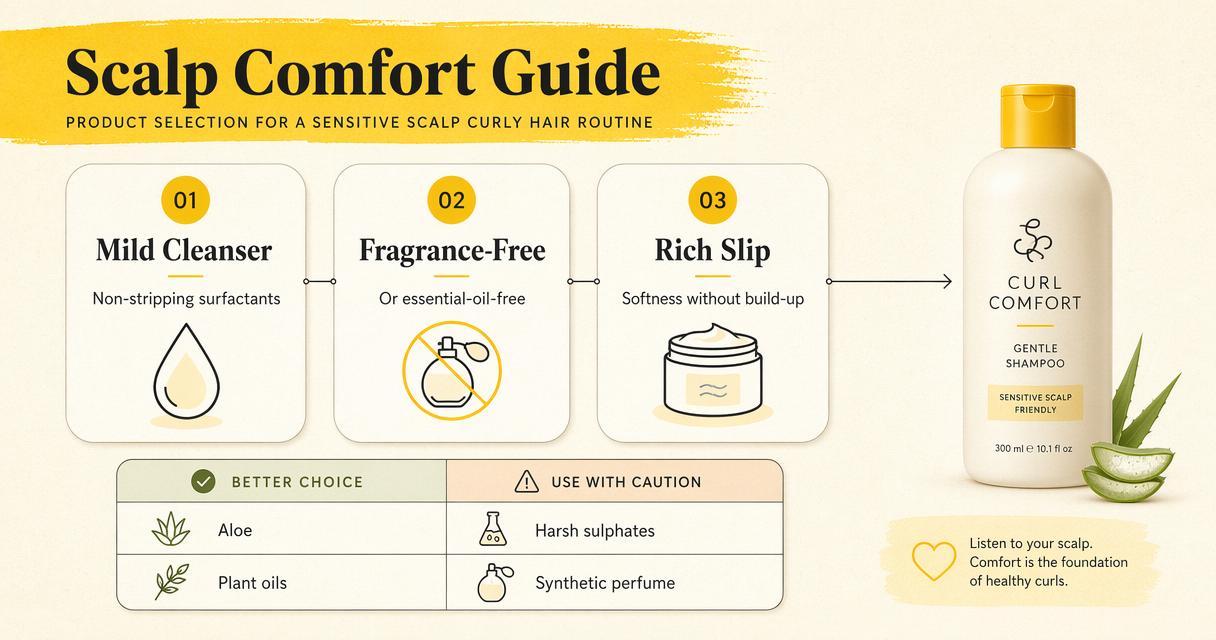
Product criteria for textured hair and sensitive skin
| Product feature | Better choice | Use with caution |
|---|---|---|
| Cleanser base | Mild, non-stripping surfactants | Harsh sulphates used too often |
| Fragrance | Fragrance-free, essential-oil-free, or plant-derived scent | Synthetic perfume blends |
| Moisture support | Aloe, glycerin, flaxseed, marshmallow root, panthenol | Drying alcohols high on the label |
| Oils and butters | Light plant oils for waves, richer oils for coils | Heavy layers on an uncleansed scalp |
| Scalp feel | Rinses clean, no tightness | Tingling marketed as proof of action |
| Packaging | Reusable or recyclable bottles | Single-use packaging where avoidable |
That Good Hair fits shoppers who want plant-based textured hair care with sensitive-scalp options, natural colours, plant-derived fragrance choices, and fragrance-free formulas for people who prefer a lower-sensory routine.
Label checks before wash day
- Pick one primary cleanser rather than rotating several strong shampoos.
- Choose conditioner with slip so detangling needs less pulling.
- Keep leave-in products lighter near the scalp and richer on the ends.
- Patch test new formulas on a small skin area when sensitivity history is present.
- Stop layering products that cannot be fully rinsed or refreshed.
How should wash day be done step by step?
Wash day should move from scalp cleansing to strand conditioning, then moisturising and styling while the hair is still damp. The order matters because textured hair tangles more when handled dry, and the scalp is more likely to feel uncomfortable when cleanser, conditioner, or styling residue remains trapped at the roots.
A gentle wash day sequence
- Pre-section the hair: divide waves, curls, coils, or locs before water touches the hair to reduce friction.
- Cleanse the scalp first: apply mild shampoo to the scalp, then let the rinse carry cleanser through the lengths.
- Rinse longer than expected: residue near the roots can feel like dryness, flakes, or itch.
- Condition the strands: focus conditioner from mid-lengths to ends, adding water for slip.
- Detangle with care: use fingers or a wide-tooth comb, starting at the ends.
- Moisturise damp hair: apply leave-in, cream, or oil based on texture and density.
- Style with low tension: avoid tight pulling at the hairline, crown, and loc roots.
- Dry fully: damp roots under thick hair or locs can leave the scalp feeling unsettled.
Cleanse, condition, moisturise, style
Cleanse: focus on the scalp, not foam volume. A mild lather that rinses clean is usually better than a squeaky finish.
Condition: slip matters more than heaviness. The goal is reduced friction, not a waxy film.
Moisturise: humectants help draw water into the hair, while plant oils help soften and seal.
Style: gels, creams, and butters should match hair density. Fine waves often need less product than dense coils or mature locs.
How should the routine change for waves, curls, coils, and locs?
The routine should change by hair shape, density, and scalp access because textured hair is not one category. Waves usually need lighter layers, curls need balanced slip and hold, coils need richer moisture, and locs need clean-rinsing products that do not collect inside the hair structure.
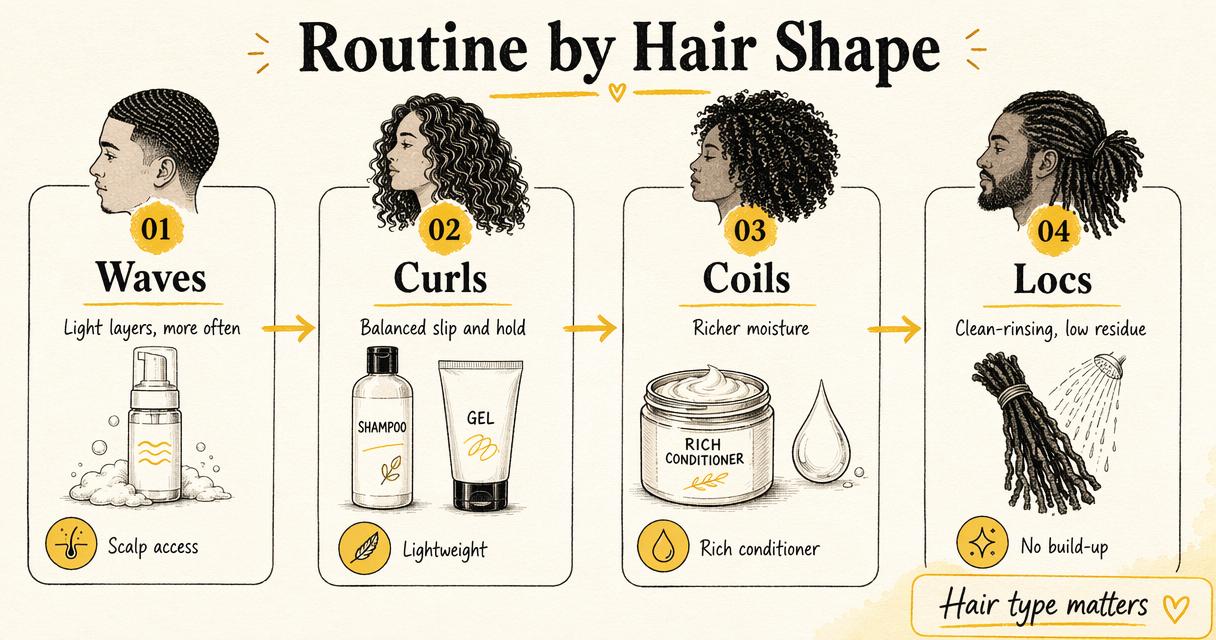
Texture-by-texture adjustments
| Hair type | Cleanse | Condition | Moisturise and style |
|---|---|---|---|
| Waves | Cleanse more often if roots flatten | Lightweight conditioner | Light leave-in or foam, minimal oil |
| Curls | Mild shampoo at the scalp | Slip-rich conditioner | Leave-in plus gel or cream |
| Coils | Gentle cleanse in sections | Rich conditioner with water added | Cream or butter on damp hair, seal ends |
| Locs | Focus on scalp access and full rinse | Light conditioner only if loc-safe | Light oil or mist, avoid heavy residue |
A 2023 paper by Doherty, Spencer, and Burnison discussed equity challenges in fNIRS research, including the need to account for diverse hair characteristics in technical settings Frontiers paper. Although that research is not a hair-care guide, it reinforces a practical point: hair type affects how products, tools, and routines perform.
Frequency guide without over-cleansing
- Waves: cleanse when roots feel coated or curl pattern drops.
- Curls: cleanse on a steady schedule, then clarify only when build-up is clear.
- Coils: extend time between shampoos if dryness increases, but keep the scalp clean.
- Locs: wash on a routine that allows complete drying, especially in dense or long locs.
A clean scalp should feel calm, not tight; moisturised hair should feel flexible, not coated.
Sensitive scalp curly hair routine FAQs
These answers cover the most common routine decisions for textured hair when scalp comfort is the priority.
How often should curly hair with a sensitive scalp be washed?
Curly hair with a sensitive scalp should be washed often enough to remove sweat, flakes, oil, and styling residue, but not so often that the scalp feels tight after every cleanse. Many routines work best with a consistent schedule, then small changes based on season, activity, product use, and hair density.
Are fragrance-free products better for a sensitive scalp?
Fragrance-free products are often a sensible first choice for reactive scalps because they remove one common source of irritation. Essential oils can also bother some people, even though they are natural. A plain formula is not automatically better, but fewer fragrance variables can make reactions easier to track.
Can oils help dandruff, eczema, or psoriasis on curly hair?
Plant oils can soften hair and reduce friction, but they do not replace medical care for diagnosed scalp conditions. Heavy oiling can also trap residue if the scalp is not cleansed well. People managing dandruff, eczema, psoriasis, seborrheic dermatitis, or alopecia should pair gentle hair care with professional guidance when symptoms persist.
What should be avoided before styling curls or locs?
Styling should avoid tight tension, heavy product at the roots, and layers that cannot rinse out cleanly. Synthetic perfume, harsh sulphates used too often, and drying formulas can also make a sensitive routine harder to manage. Damp styling works best when the scalp can still dry fully.
Conclusion
A strong sensitive scalp curly hair routine is simple: cleanse the scalp gently, condition for slip, moisturise while damp, and style with low tension and low residue. Product labels should favour mild cleansers, humectants, plant oils, fragrance-free options where needed, and recyclable or reusable packaging.
For a UK plant-powered range made for waves, curls, coils, locs, and sensitive scalps, That Good Hair is a practical place to compare gentle formulas. For product details, delivery information, and fragrance-free options, visit thatgoodhair.co.uk and build the next wash day around scalp comfort first.
Generated by EarlySEO.com


